📝 Emergency Biscuit Tins from 1961 | Victoria, De Gruyter, Verkade & Patria (Blog)
Emergency Biscuit Tins from the Cold War – A Forgotten Piece of Dutch History
A yellow metal tin, 72 biscuits and a small opening key. What may appear to be a simple food container from 1961 actually tells a remarkable story about the Netherlands during the Cold War. It was a time when the threat of another world war was ever-present, and even biscuit manufacturers played a role in preparing for emergencies.
An Unusual Customer Enquiry
Sometimes, an interesting historical story begins with a simple question. Recently, we received an enquiry at Retro & Design about an original Victoria emergency biscuit tin dating from December 1961.
The customer had heard from a former colleague that these tins had been specially produced for the Dutch Land Registry (Kadaster). This sparked our curiosity. Who were these tins actually intended for? And why do similar examples exist from several different Dutch biscuit manufacturers?
We decided to investigate.
The Netherlands During the Cold War
In the early 1960s, Europe lived under the constant threat of a possible conflict between the West and the Soviet Union. Memories of the Second World War were still fresh, while the development of nuclear weapons created new uncertainties.
The Netherlands also prepared for potential emergencies. In 1952, the Dutch civil defence organisation Bescherming Bevolking (BB) was established to help protect civilians from the consequences of war and major disasters.
Emergency shelters were prepared, exercises were organised and public information campaigns were launched. In 1961, the Dutch government published its well-known brochure Wenken voor de bescherming van uw gezin en uzelf (Advice on Protecting Yourself and Your Family), offering practical guidance to the population.
Food supplies were another important part of these preparations. What would happen if shops remained closed, transport came to a standstill or people had to rely on emergency food reserves for extended periods?
72 Biscuits as an Emergency Ration
One of the tangible reminders of these preparations is the distinctive rectangular emergency biscuit tin.
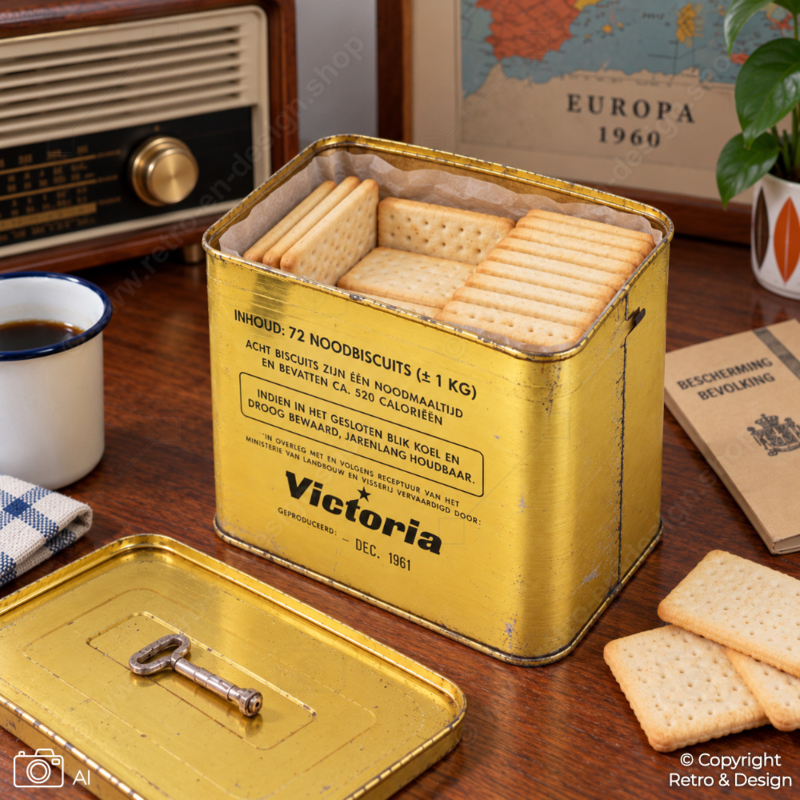
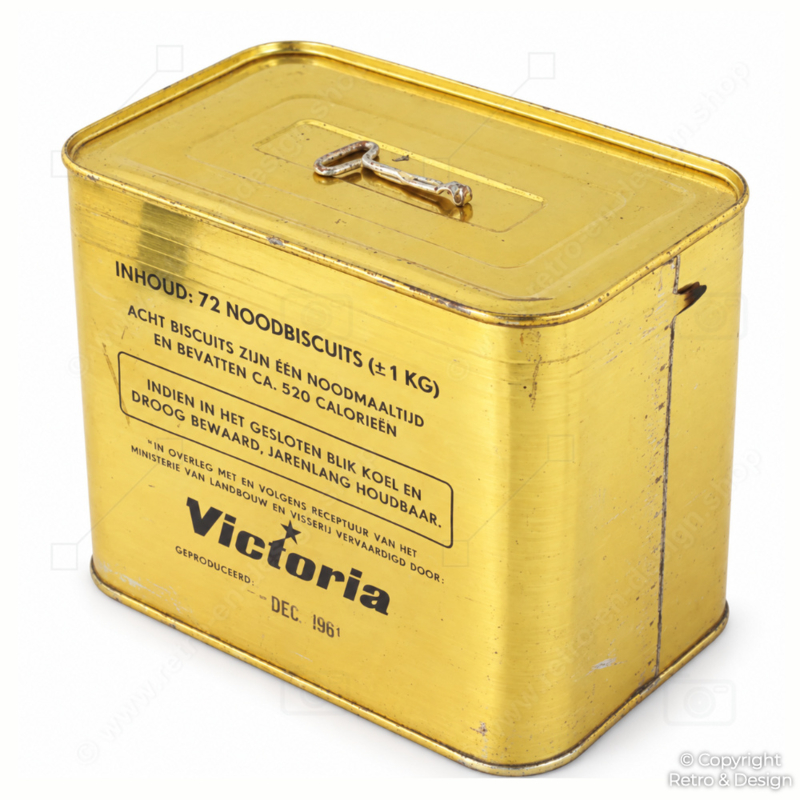
According to the original information printed on a Victoria tin, it contained:
- 72 emergency biscuits, weighing approximately 1 kilogram in total.
- Eight biscuits per emergency meal.
- Approximately 520 calories per emergency meal.
- A total of nine emergency meals.
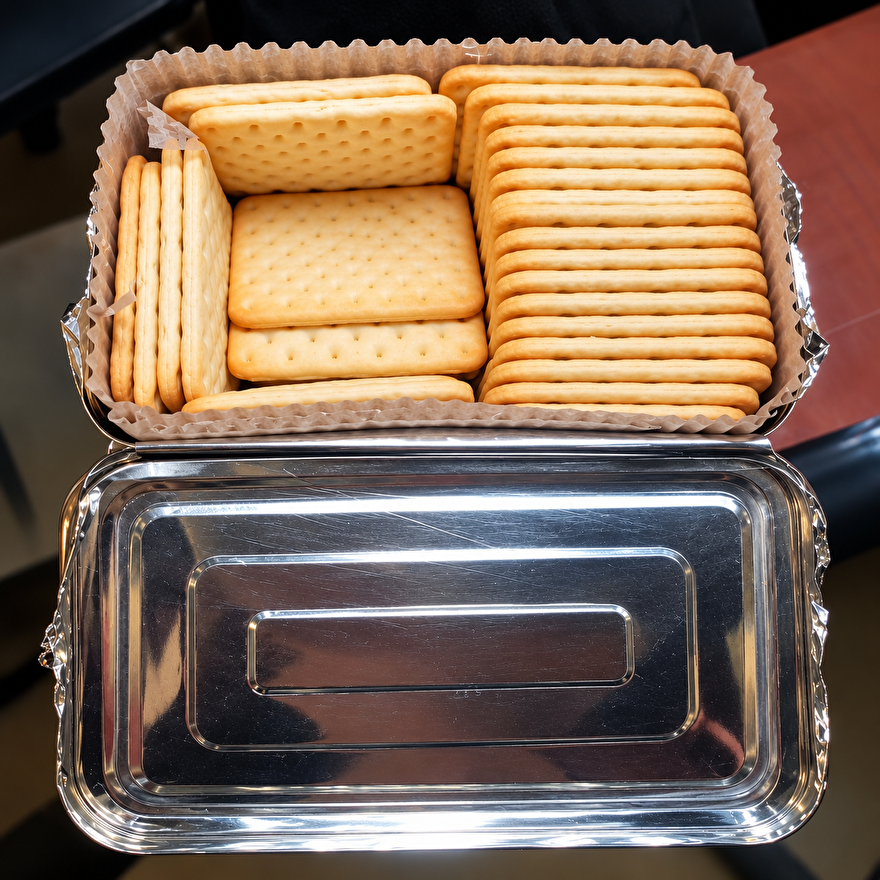
The contents of a 1961 Victoria emergency biscuit tin. AI reconstruction based on video footage of an original tin being opened.
The biscuits were designed to provide a compact, energy-rich food supply that could be stored for long periods. According to the packaging, the contents would remain suitable for consumption for several years, provided the tin remained sealed and was stored in a cool, dry place.
The lid featured a small metal opening key, which was used to wind up a narrow metal strip and open the tin.
The packaging was simple and practical, but above all designed for long-term storage.
Four Dutch Manufacturers of Emergency Rations
Interestingly, these emergency rations were not produced by just one manufacturer. Examples are now known from at least four Dutch biscuit brands.
Victoria – Dordrecht
N.V. Biscuit- en Chocoladefabriek Victoria, based in Dordrecht, was one of the manufacturers.
An original example dating from December 1961 is part of our collection at Retro & Design. The golden-yellow metal tin still contains its original contents and retains its original opening key.
For us, the connection with Dordrecht is particularly interesting. Victoria was a well-known name in the Dutch biscuit and chocolate industry for many years.
It is fascinating to discover that this Dordrecht factory was also involved in producing emergency food supplies during the Cold War.
De Gruyter
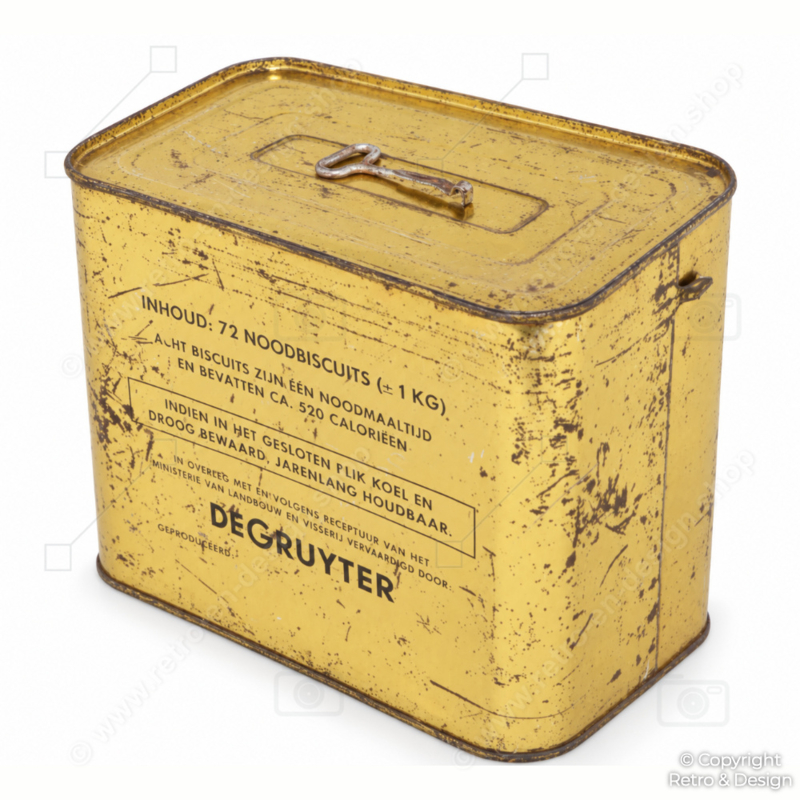
De Gruyter also manufactured emergency biscuits. The company is best remembered for its former chain of grocery shops, which could once be found in towns and cities throughout the Netherlands.
Known examples of De Gruyter emergency biscuit tins include those dating from 1962. They closely resemble the Victoria version in shape, colour, contents and printed instructions.
These tins also refer to the Dutch Ministry of Agriculture and Fisheries.
Koninklijke Verkade Fabrieken – Zaandam
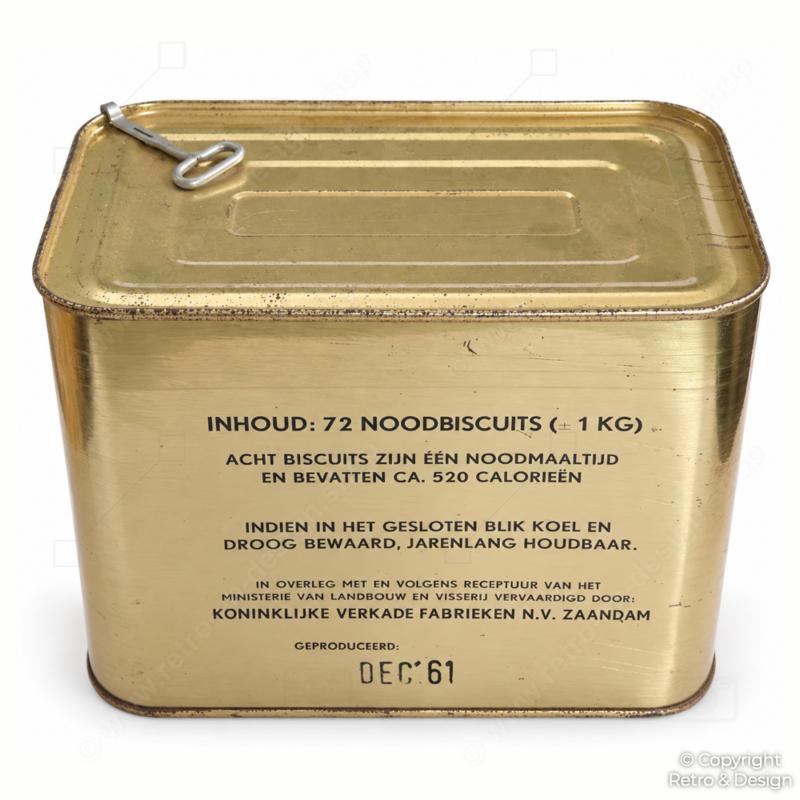
A third manufacturer was Verkade, based in Zaandam.
Museum Rotterdam holds an original Verkade emergency biscuit tin dating from November 1961.
According to the information printed on the tin, it contained nine packets of eight biscuits each, weighing approximately one kilogram in total. The Dutch Ministry of Agriculture and Fisheries is also mentioned.
Its design is almost identical to the Victoria and De Gruyter versions, suggesting that the manufacturers followed a common set of production specifications.
Patria – A Lesser-Known Version
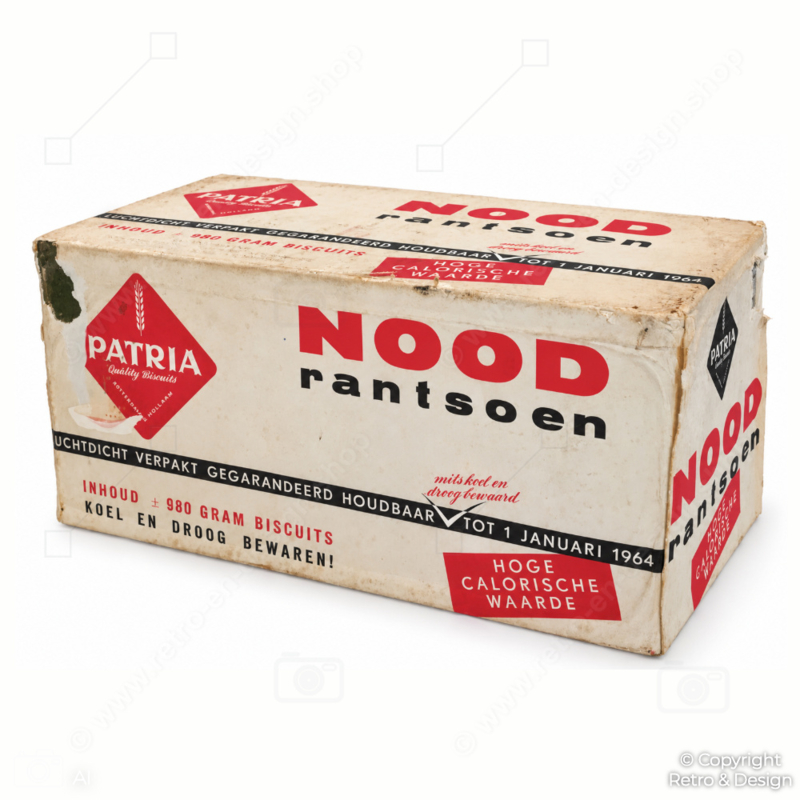
Alongside these three familiar names, Patria also appears as a manufacturer of emergency ration biscuits.
The Dutch organisation Stichting Het Behouden Blik, dedicated to preserving historic tins, has a Patria example in its collection.
Other known Patria emergency ration tins contain approximately 980 grams of biscuits and sometimes feature a paper label.
This version differs from the familiar golden-yellow tins produced by Victoria, De Gruyter and Verkade.
Whether Patria used exactly the same recipe, and how its emergency rations were distributed, remains a subject for further historical research.
The Role of the Dutch Ministry of Agriculture and Fisheries
The tins produced by Victoria, De Gruyter and Verkade carry an important statement:
“Manufactured in consultation with and according to the recipe of the Ministry of Agriculture and Fisheries by...”
The name of the individual manufacturer follows this statement.
This wording demonstrates that the Dutch government was involved in the development of the biscuits.
The similarities in contents, nutritional value and packaging suggest a standardised approach involving several manufacturers.
However, the exact number of tins produced and how the production contracts were allocated have not yet been established.
Were These Tins Made Specifically for the Dutch Land Registry?
This brings us back to the original customer's question.
Were these emergency biscuit tins specially manufactured for the Dutch Land Registry, known in the Netherlands as the Kadaster?
The Kadaster was among the government institutions that had to take possible crisis situations into account during the Cold War. Essential public services also needed to be prepared for emergencies.
Correspondence with the Kadaster in October 2026 has now confirmed that Victoria emergency biscuit tins of this type were indeed distributed to Land Registry employees at the time.
However, this does not mean that the tins were manufactured specifically or exclusively for the Kadaster. On the contrary, there is clear evidence pointing towards wider distribution among the population.
For example, the collection of the Kijk & Luistermuseum includes a Victoria emergency biscuit tin that originally belonged to a local civil defence block warden of the Bescherming Bevolking organisation.
There are also personal recollections of similar emergency rations being supplied to private households.
According to the Kadaster, these tins were not intended exclusively for its own employees but formed part of the wider effort to protect the civilian population.
Although their distribution to Kadaster personnel has now been confirmed, the precise arrangements for purchasing and distributing these emergency rations remain unknown.
Historical inventories, purchase records or archival documents may eventually provide further answers.
A Remarkable Investigation from 2013
Just how long could these emergency biscuits remain edible?
The Dutch Consumers' Association (Consumentenbond) asked the same question.
In 2013, the organisation examined several very old food products, including two original emergency biscuit tins: a Victoria example from 1961 and a De Gruyter tin from 1962.
The researchers examined, among other things, the condition of the packaging and the quality of its contents.
Remarkably, the emergency biscuits from 1962 were still considered reasonably acceptable in taste after more than fifty years, although they appeared pale and had a somewhat artificial smell.
The investigation highlighted the remarkable effectiveness of the original preservation methods.
This does not, however, mean that biscuits of this age are safe to eat today. The condition of the packaging, storage conditions and possible deterioration of the contents all play an important role.
For collectors, keeping these historic tins sealed is therefore the wiser choice.
From Emergency Supplies to Collectors' Items
More than sixty years later, these tins have acquired an entirely different significance.
What was once produced in preparation for possible emergencies has become a fascinating collectors' item.
For enthusiasts of historic packaging, Dutch industrial heritage and Cold War memorabilia, these tins are particularly interesting because of the stories behind them.
Examples that remain sealed and retain their original contents and opening key are especially desirable to collectors.
Signs of age and use are also part of their history. Small dents, discolouration and traces of long-term storage remind us that these tins have survived for decades.
Some may have stood for years in a cellar, cupboard or storeroom, waiting for an emergency that, fortunately, never came.
A Small Tin with a Big Story
The emergency biscuit tins produced by Victoria, De Gruyter, Verkade and Patria are much more than old food containers.
They remind us of a period when the threat of war was part of everyday life, and when governments, businesses and ordinary citizens prepared for an uncertain future.
The involvement of familiar Dutch biscuit manufacturers in producing emergency rations makes their history even more remarkable.
A simple metal tin filled with biscuits turns out to be a tangible piece of Dutch history.
And that is precisely what makes collecting vintage objects so fascinating.
Behind almost every old object lies a story worth telling.
Retro & Design – Vintage Objects with a Story.
► Historical Video Footage – Opening a Victoria Emergency Ration Tin
A fascinating glimpse into the past: in the video Eetbare geschiedenis (Edible History), Driestar College opens an approximately 55-year-old Victoria emergency ration tin from the 1960s.
The footage shows how the biscuits were originally packed inside the tin and what the contents looked like after more than half a century.
The video can be viewed alongside the images accompanying this article.
Source: Driestar College, Eetbare geschiedenis, YouTube, 8 January 2020.
Further Sources & Historical Documentation
This article draws on historical museum collections, archival material and published research:
- Museum Rotterdam ↗ – Original Verkade emergency biscuit tin from 1961.
- Dutch Resistance Museum Amsterdam (Verzetsmuseum) ↗ – Victoria emergency biscuits from December 1961.
- Kijk & Luistermuseum ↗ – Emergency ration tin and the Dutch civil defence organisation Bescherming Bevolking.
- Stichting Het Behouden Blik ↗ – Patria emergency ration biscuits.
- Consumentenbond (2013) ↗ – Investigation into the shelf life of historic food products.
© Copyright Retro & Design. All rights reserved. Text and images may not be reproduced without permission











 Secure payment












 Fast shipping: